The Bus Driver I Bruised (An Easter Story)

The first day of kindergarten I wanted to walk to the bus stop all by myself, so I put my backpack on, held my strawberry shortcake lunchbox in one hand, and told my parents to stay home. I walked a long way up our dirt road, past the gardens, past a neighbor’s house with a barking dog and up a hill to the spot where I was to wait for the bus. I didn’t know Papa and Mama were following behind, being careful to stay out of sight. The bus stopped and I climbed on board all by myself, feeling every ounce independent and brave.
32

But it was toward the end of October that we all moved, except for Papa who stayed behind. I remember the kitchen in our new home with the cupboards that I couldn’t reach. Once, I stood next to the counter, my head just about its height, while Mama and Papa looked down at me sadly and said, “Lara, we need to talk with you.” Their faces looked serious as they told me that they were getting a divorce. I remember I didn’t know why they looked so sad.

At our new house, I was supposed to wait for the bus just at the end of our short driveway but for some reason I would wake up with knots in my stomach. I just knew I couldn’t go to school. I told Mama that I didn’t feel good, day after day. Becoming a single mother, she had gone back to work and my grandmother was living with us to help out. I’m sure Grammie B noticed that after the bus left I would be all better and would spend the rest of the day playing with my little sister. Papa took me to the doctor once, and the tall, perceptive man diagnosed me with ‘anti-school-itis’ and said that I should be home for the rest of that day but to get on the bus in the morning.

But just like every day, I woke up and the thought of school made my stomach twist into knots. Once, I pretended to wait for the bus, and Grammie B didn’t notice that I ran around and hid in the pine trees behind our house. The bus came and left and I gave her quite a shock when I showed up hungry for a snack an hour or so later. She called my other grandmother to come and take me to school, because she said she didn’t have the heart to do it. So, Grammy J drove down one hill and up another, loaded me in her car and took me to school. Years and years later she would still talk about how she had to drag me inside and leave me there and of how afterwards she sat in her car and cried. She was sure to always remind me that Grammie B made her be the bad one. I think she was always relieved to see my smile when she told the story.

In a small town, with family and friends all around, people help each other out. My bus driver was named Bob. I think he might have owned a garage in town and he would pick me up and drop me off each school day. At least, he would try to pick me up. There were days that I just would refuse to go to school. He would get off the bus, kneel down and talk with me. He was kind and would smile and try to encourage me that school wasn’t such a bad place to be and assure me that he’d be bringing me home again that afternoon. But I wouldn’t go. One morning he and my mother had a talk in low voices while we all stood at the end of the driveway. He came over and picked me up to put me on the bus. I turned into a little wild beast, kicking him and hitting him. But, somehow, he got me on the bus and plopped me in a seat.  I don’t remember how many times this happened and he was kicked and hit and scratched putting me on his bus. I know that every time I lost the battle to stay home, I cried the whole way to school. Usually once I got there I ended up having a good day and rode home with a smile on my face. I would say, “thank you,” to Bob as I was getting off at home, as my mother had taught me it was important to be polite, but I would be ready to fight him all over again in the morning.

One year, after Grammie B started going to Florida for the winters, I would often get on and off the bus at Grammy J’s house.  I would be the last one to be dropped off during those times. Bob was used to just driving past my grandmother’s road because usually he didn’t have to go that way. After dropping off the last kid, his mind was already mulling over the things he’d do when he got home. Over and over again he almost forgot to make the turn. I’d have to holler down the aisle, “Bob!! I need to go to my Grammy’s house!” He’d put on the brakes fast and sometimes have to back up. He’d say, “Whoa! I was almost going to take you home with me today!” One day, after almost being forgotten again, I stopped and said more than ‘thank you’ to Bob. “Bob, you keep forgetting me. Next time you forget, I’m not going to say anything. So you better remember.” And then, I said “thank you”, and hopped off the bus. I’m pretty sure it was the next day that I rode all the way home with Bob. He got the bus all parked neatly in his driveway and started to get off when I spoke up. “Bob! I’m still here.” He looked pretty surprised, and laughed, and backed the bus back out of his driveway. Never once did he forget the turn at my grandmother’s road after that!

I don’t remember when Bob stopped being my bus driver. I had almost forgotten all about him until one Easter Sunday, many years later, when I went to church with my grandmother. Bob came over to greet me and he pretended to shy away like I was going to hurt him as he said, “I’ve still got bruises from you!” He still had the kind smile and we laughed about my antics as a little kid.

I didn’t go to church often but both my grandmother and older sister went to the same church as Bob. When I was a young teenager, my older sister (who had grown up and gotten married) would sometimes pick me up and bring me to this church’s youth group. I always felt a little out of place, as I didn’t know many of the kids there or what all of this Christianity stuff was really all about.

But, one night, Bob and his wife Nancy were leading the lesson. I don’t remember anything about what passage of the Bible he was teaching from, or what we were supposed to be learning. But, I’m pretty sure he paused at one point and wrote his telephone number on the blackboard. I remember he looked around the room, at some rowdy teenagers, including this one that long ago had left him with scratches and bruises, and told us that he loved every one of us. He said that he wanted us to know that we could call him anytime of the day or night. If we ever needed anything, whether it was a friend to talk with or we were in some type of trouble, he would do his best to help. He looked over at his wife, smiled, and said, “Nancy and I don’t mind if the phone rings at 2AM… you just call if you need us.”

I have never forgotten that, though up until a couple of weeks ago, it had been a long time since I’d thought of my old bus driver.

One Sunday, I told the story of ‘when Mrs. Mather was a little kid and didn’t want to go to school’ to a group of shocked five, six and seven year olds in junior church. I held the Bible my grandmother gave me when I was seven and still struggling with anxiety, and we went through Psalm 23, which was a passage she had me memorize all those years ago.

When I got home from church that day, I was still thinking about Bob. I was pretty sure I’d heard that he had passed away a decade or so ago. I typed in his and his wife’s names and did a quick internet search to see if I could find out anything more about him as everything I’ve written here is all that I remember.

I saw that his widow, Nancy Hannington, had written the ‘Morrill town news’ segment in the local paper. This is part of her article printed in the Republican Journal, August 6, 2010:

“I am sure many of you recognize at least the first few bars of “Just as I Am” from hearing it through the Billy Graham Crusades. Charlotte Elliot from Brighton, England was completely embittered over her broken health. Through a conversation with a Swiss minister in 1822 she finally asked, “If I wanted to share the peace and joy you possess, what would I do?” The pastor answered, “You would give yourself to God just as you are.” Charlotte did come to Him, just as she was. Years later, she wrote a poem for a fundraising project that was printed and sold across England. That poem was set to music and has become the most famous invitational hymn in history. Although never in good health, she lived to be 82 years old. Loved ones sifting through papers after her death found over 1,000 letters from people expressing their gratitude for the way this hymn had touched their lives. By the way, this was my Bob’s favorite hymn.

Excerpts from the above paragraph were from “Then Sings My Soul” by Robert J. Morgan.”

I love that this is what I found out about Bob.

Just as I am, without one plea, but that Thy blood was shed for me…

He gave himself to God, just as he was. He got out of his bus to help a little girl that was hurting and scared, and he got kicked and hit and beaten with as much violence as a five or six year old girl is capable of handing out. But he took my fury to help me get to the place I needed to be. And even years later, he was still holding out an offer of grace, and love, and help.

I’m so thankful for all the ‘Bobs’ in my life. I come to them just as I am. On the hard days, they let me be hurt or messed up or angry or scared. At times they’ve even taken some emotional blows. It’s those people who have seen my worst, and showed me grace, that get my phone calls when my world is falling apart. They hear my confessions and my anxieties and they remind me again and again of grace.

They point me to the One that didn’t just suffer some kicks and scratches, but that took everything I have to be ashamed of or broken by and suffered to a degree that I will never fully understand.

Long ago, one Easter Sunday, I stood in a little church in Maine, and a man came up and reminded me that I had bruised him. This year, I’ll stand in another little church. I’ll look at all the ‘Bob’s’ around me, singing and clinging to grace, and I’ll remember the Savior that I bruised and wanted to hide from for so long. I’ll remember how he left Heaven to make a way for me to be brought Home. Day and night, He bids me to come, and call on Him. Oh, Lamb of God, I come, I come!

The Taste of Ashes and Redemption

The Taste of Ashes and Redemption

Somewhere in my blood there’s likely pagan ancestry mixed there with the puritan. Far back there might have been grandfathers or grandmothers that danced around trees in the moonlight. I thought of this once, during a time when I was tired. If I were a pagan I could look around at the world and find objects that give me a feeling of wonder, like the ocean or trees, mountains or moon, and I could make them my gods. My gods would think the way I do so their judgments would make sense to me. I would dance to make them do the things I want, like bring the rain or give me babies or heal my loved ones. Yes, I thought, maybe I could be a pagan.

The trees would be the first gods I’d bring to life. For all my love of the ocean, I am a shore dweller. Roots appeal to me and so does the idea of being firmly grounded. When I had my babies, the midwives encouraged me to try water births. But always there came a point when I needed to be out of it; frantically I needed to have my feet on something solid. When in labor with my third son, the nurses let us leave my room and walk in the woods behind the hospital.  It was a warm day in May, and my husband and I paused beneath a hardwood tree with a wide trunk and fresh, new leaves. Leaned against it, breathing deeply, I felt the pain stop as the labor continued. Finally I felt myself grounded, with the roots of this giant tree stretching deep into the earth beneath me. Drawing from the strength of that immovable tree, I felt new life moving through me unhindered. When we went back inside to the hospital room, I tried to bring the strength and rest I felt under the old tree with me. Before long my baby boy was in our arms. My husband calls him now ‘the boy who notices things.’ Yesterday I walked with him in the woods, just he and I, and again I understood why my husband says this. This boy loves the winter snow because of the tracks. He pointed out ones made by squirrels and rabbits. He showed me how to tell the coyote tracks apart from those of the big-pawed black dog romping around us. He took me off the path to see where the squirrels have a hole in the ground to store their food, and the log they sit on to eat in the sunshine, with the debris scattered around like crumbs left on the floor by children. We followed deer tracks and saw where they’ve been biting off the delicate buds of beech trees. He remarked to me, “I am so glad we don’t live in the city.” I smiled with him, and pointed out the trees stretching out as far as we could see up the hill and against the blue-grey winter sky.

During these winter months, when I sit in front of our warm woodstove, I sometimes think of a book I read once called, ‘The Trees in My Forest’, by Bernd Heinrich.

He said, “I’m sure the BTU equivalent of energy captured by a growing tree has been calculated to the third decimal point, but to me that figure provides less meaning than the heat I feel when I burn a stick of wood in my cast-iron stove. Two or three dried split pieces of rock maple can make it glow red-hot, warming the stove and the house. Heat is a form of energy. The source of energy, captured by the trees’ leaves, is the sun. Multiplying the potential energy of those two to three pieces of split wood by the untold thousands of logs accumulating in the trees all around me, I am awed by the sheer magnitude of energy that drives life, passing from one form to the next. The energy captured by trees and other plants will eventually be tapped by bacteria and fungi, by insects and other herbivores, and then passed on to birds and other predators, like us.

Given the constant extravagant input of energy into the forest and into life, it is a small wonder that the evolution of the most extraordinary complex creatures, as well as human civilizations, has been possible. After looking at trees, and heating coffee on my woodstove, it is not difficult to comprehend how life can proceed toward incredible complexity, such as a hummingbird or moth, in a seemingly “uphill” direction from chemical chaos.”

I read those words once, before a walk in the woods. One thing I’ve always had trouble with, in thinking about scientists that don’t believe in a Creator, is how they manage to reconcile the wonder all around them in the natural world with lack of design and intention. But here, I thought, maybe this is it. Maybe they have a way to wonder enough at the world, that the world itself becomes god enough to be its own creator.

On my walk, after reading Heinrich’s words, I tried to share in his wonder; to be an atheist and to still experience awe. Just for a moment, I stood in the snowy woods with that quiet that only winter can produce all around me. I looked around me at the trees. I let myself think deep about the energy in their roots and in their trunks and branches and multiplied across trees as far as I could see in every direction. I tried to let go of every religious presupposition and just feel energy swirling around me. And there, in that attempt to empty myself of faith, something swelled in me that affirmed again that it wouldn’t work. From the core of me rose words that make atheism impossible. At the height of experiencing wonder and beauty and awe, the words, “Thank you,” swelled up beyond my control. I couldn’t stop them. There they rose; reaching beyond myself and these woods toward One my soul has started to know.

Long ago a woman stood underneath a tree, gazing up at its branches laden with fruit, and listened to the lying words of the devil. He planted doubts about the goodness of God in her mind, and she became the mother of all doubters.

A true daughter of Eve, I’ve had a tendency to be a great doubter. For years and years my favorite hymn was one that contained the lines, ‘Prone to wander, Lord, I feel it, prone to leave the God I love…” But somehow, as the days and years go by, I’m forever becoming less of a skeptic. He has loved me with a keeping strength. I feel it working, tilling my heart at times, and the worship that rises from that overturned soil is for Him alone. Long ago, with those first meager glances at the tree of Calvary, He planted a seed in my heart and now even my doubts have become tools to break apart hard ground and let my roots go deeper.

A pastor in Manhattan, Timothy Keller, once said, “A faith without some doubts is like a human body with no antibodies in it. People who blithely go through life too busy or indifferent to ask the hard questions about why they believe as they do will find themselves defenseless against either the experience of tragedy or the probing questions of a smart skeptic. A person’s faith can collapse almost overnight if she failed over the years to listen patiently to her own doubts, which should only be discarded after long reflection.”

I’ve learned to notice and to lean into my persistent questions and not to leave them unattended. Some wonderful day I trust that all these doubts will pass away forever, but until then they propel me to use my mind and my heart together to seek and to know. Always, so far, these times of honest questioning have given birth to deeper faith.

Jesus has always been willing to listen to and answer an honest question.

When the hungry crowds pressed in around him they asked, “What must we do to be doing the works of God?” Jesus’ answer was that they must believe in him.

Another time, when asked what the greatest commandment was, Jesus said that it was to “…love the Lord your God with all your heart and with all your soul and with all your mind and with all your strength.”

These things aren’t pretty sayings to stick on the refrigerator and feel inspired to be a better person. They are crushing if we know ourselves and we’re left to ourselves. Those who have tried to love anyone, and to love them completely, know this. The only one I naturally love with all my heart, soul, mind and strength is myself. Life has been a long and sobering revealing of that reality. This inability to believe in God and to love Him is at the core of what the Bible calls sin. From it every other sin sprouts as we work to fill a hungry place in us designed for worship.

If it were not for another tree, one without roots and branches, we would all be left to our own means to try to fill that void. We would make our own gods, each a reflection of our own hearts. We’d stay self-worshipers ever growing more self-holy. We would be designing and furnishing our own Hell.

There are so few today that see the cross as beautiful. But some, untangling and pulling weeds of doubt as they walk ever closer, fix their gaze on the tree where Jesus hung, cursed, not for His but for our own transgressions. Here we find the restoration of our worship.

I drew strength the day my son was born from a massive and glorious tree. There was something sacred and holy about that moment as I leaned against its solid trunk.

But hours later, when I held that baby in my arms, it wasn’t to the tree that I whispered my thanks.

There are times when I can almost hear the mountains, waves, moon and the great trees singing a song that causes worship to rise in my soul. But if I try to sing to them my voice is lost to the wind. They have no ears to hear my voice and no words to answer.

In the Bible the prophet Isaiah describes a man who goes into the forest and chooses a strong tree. He cuts it down and with part of it he kindles a fire, warms himself and bakes bread. Another part of the tree he carves into a god and worships it. He prays to it and says, “Deliver me, for you are my god!” (Isaiah 44:14-20)

About this man Isaiah said, “He feeds on ashes; a deluded heart has led him astray, and he cannot deliver himself or say, ‘Is there not a lie in my right hand?’” (Isaiah 44:20)

Over and over again the Bible shows us God’s people falling down before false gods of their own making. Their deluded hearts lead them astray and they feed on ashes rather than on bread and living water. And this is my heart as well.

God has proven Himself faithful to me in countless ways. He has saved me and made Himself known to me. He has met me in prayer and He has opened up His Word and my eyes to see His story. I’ve shared in all of the blessings He’s poured out on His people, most importantly the treasure of being able to be near Him.

I’ve shared in the shame of His people as well. I’ve held lies in my right hand. Even as His child, I’ve had times of turning my back and wondering if there might be some other way. I’ve complained about His ways and tried to provide for myself because I didn’t think He would give me what I need in the future even though he has never failed me in the past. I’ve clung to the people in this life that give me a sense of security while being too afraid to draw near to the God who loves me better than my dearest friend. I’ve been bitter and full of worry. I know what the ashes of idol worship taste like.

But, amazingly, I’ve also shared in the redemption of His people. I’m a branch that has been grafted into the promises.

The passage in Isaiah goes on to say,

“Remember these things, O Jacob,
and Israel, for you are my servant;
I formed you; you are my servant;
O Israel, you will not be forgotten by me.

I have blotted out your transgressions like a cloud
and your sins like mist;
return to me, for I have redeemed you.

Sing, O heavens, for the Lord has done it;
shout, O depths of the earth;
break forth into singing, O mountains,
O forest, and every tree in it!” (44:21-24)

The beauty of these words makes my heart ache in worship.

Once I heard someone ask the question, “Would you be happy if you could have Heaven, with all its treasures of life and wellness and beauty, with reunion with loved ones and all that Heaven contains, if only God were not present?” Like the thank you that rises beyond my control when witnessing beauty, this question forever affirms my faith.

No, I wouldn’t be happy if He were not present; this God that I will never be forgotten by but that I must be told to remember. No god of my creating can replace the God who formed me. Would I rather have a god in my control or a Sovereign who has made my sins lift like the mist? All the energy in the world, most literally, cannot fill my soul as He does. Only the One who has etched by hand and thought, and is the source of all, can fill me with true worship. This breaks forth just as it does with the heavens, earth, mountains and forest- yes, even every tree. My worship is restored through His redemption of my soul and with each remembrance of it. Yes, with the rest of creation I will break forth into singing, “…for the Lord has done it!

Providence and My Anxious Heart


“Someday you or I will die.”

“Lara, that won’t happen for a long, long time.”

“But, Mama, it really is going to happen.”

“Shhhh… it will be okay. We’ll just cross that bridge when we get to it.” 

I was five or six years old and my mother was trying to comfort me. But, I remember how I lay awake, looking into the darkness of my room, and thinking about this bridge in the distance. It didn’t matter how far away it was; someday we would have to walk across it. It was real.

I can still be overcome at times with anxiety. It rises up when I hear that my husband has to travel for work, or that one of my children isn’t feeling well, or that a snow storm is due to hit town right when I need to be driving somewhere. I start imagining awful things and grieving for sorrows that haven’t happened yet.

I’ve felt tension between how overwhelming this anxiety is and the Biblical commands not to worry. Over and over again, my Lord tells me, “Do not fear.” And yet, despite that and all my self-talk about the futility of anxiety, I still fear.

This winter, now that the cold and snow have settled in, I’m cozying up to my winter project. In the spare moments, or evenings, I’m opening old books, sitting before hundreds of pages of interviews, magazine articles and newspaper clippings. There are faces in old photographs, letters with pretty slanted handwriting, and stories on old typewriter paper. I’ve been researching the history of my family and roots in Maine, and starting to piece together the old stories.  As I do, the familiar sinks back into history; the hills and valleys, roads and ponds, set securely in their places suddenly are transferred back over the years to a time when my ancestors called them home. They were farmers and lumbermen, teachers, bootleggers, store keepers and mill workers. At times they were soldiers. Each name scratched on a family tree contains a lifetime of stories, though I’m often left with just a few dates to go with the name.

There’s something about letting my mind traverse the old stories that leaves me feeling both more grounded and somehow ethereal.  I can imagine how my own name would look, written out in one of these genealogical record books. It would be next to the name of my husband, with the dates of our births and marriage, and below would be the names of four sons and three daughters. Truly, we aren’t separate from history. This is just our moment to breathe and work and love and pray and hope. And it’s really just a moment.

I’m drawn to the old things and their reminders that others have walked the same roads we’re called to walk. My children all learn to read holding a one-hundred year old primer, turning the thick, brown-edged pages with their fresh little fingers. An introduction to the teacher reads, “…The subject matter is within the range of the experience and the imagination of most children of five or six years of age. It is full of incident and action. It enlists at once the liveliest interest of children…” And somehow, though these words were written about children learning how to read while the Great War was raging in Europe, my own children have their ‘liveliest interest’ enlisted as well. My sons love that some of the old books still have pictures of little boys with guns and hunting dogs. I love the simplicity of the stories; the focus on nature and agriculture. And there’s something time-surpassing about the human desire for ‘incident and action’ and things that speak into our ‘experience and imagination’. We all love stories.

Last week, amidst unexpected events and accidents and with my husband getting ready to board a plane, with anxiety swelling, I prayed and asked God for His grace to obey his words concerning worry. I trust that God, who delights when we know truth, is willing to teach us wisdom in our secret hearts. (Psalm 51:6) I’ve experienced this digging and exposing and thought-shifting work of God.

When I was a young Christian, I heard someone say that the many ‘fear God’ verses in the Bible really mean that we are to be in awe of Him. We’re to just be reverent. He’s our friend. We don’t have to be afraid of God.

But if we’ve never been afraid, I don’t think we’ve ever encountered his glory.

I’ve stood on a rocky cliff and felt spray from ocean waves on my cheeks as the wind whipped through my hair. I’ve heard their roar below me, and known that if I ventured too close they could crush me and pull me under. There’s something awesome and to be revered and also something fearful about the waves and the weight of the water crashing against the shore.

I’ve felt the same sensation as I watched a storm rumble in from the west on a summer day. The wind picks up, the sky darkens, and soon thunder is shaking the house and leaving a rumble deep down in my bones. Nature is awesome and fearful and seems to be telling us an old, old story.

But how much greater is the weight of glory that the Creator of the waves and the thunder holds? A true taste of God’s glory makes us tremble. I’ve certainly found that true prayer isn’t safe. There’s a true, appropriate, healthy fear; a fear with a purpose of leading us to salvation.

Perhaps there’s nothing that makes me feel more small and vulnerable than looking up into the night sky. Sometimes I pause on my way back to the house from some errand that has taken me into a dark night. As I look up, higher and higher into the heavens, I feel myself shrinking into exposed insignificance. The stars are some of the most humbling witnesses of God’s glory. And amazingly, Psalm 103 says, “For as high as the heavens are above the earth, so great is his steadfast love toward those who fear him…” To truly come to know God is to fear Him; a heart pounding, knees knocking, trembling fear in the face of power. But to truly know Him and fear Him is also to receive a great and steadfast love that washes our fears away. The ocean waves, with their crashing power, don’t love me. The thunder doesn’t roar promises to hold me in the palm of its hand and cover me in the shelter of its wings. But God does.

It’s this weight of power and love that is the only match for my anxiety.

Too often I’m trying to grab the pen and write my own story. I want to control the plot line, because I feel like I’m the main character. I want to keep the story pretty tame, without much incident or action, but with plenty of comfort, security and just a little poetic romance springing up from purely happy things. This is the story I want to write for all of those that I love.

But there’s an Author already and He holds the pen. Do I trust him?

He wrote a story that I don’t always understand. I don’t know why he allowed sin and suffering to stain the pages when it seems he could have kept it out. I want a beautiful ending and I want it now. But what He’s given me is a stunning climax. The crushing, fearful holiness of God met in full force the deep, steadfast love of God when he wrote himself into the story. This is the gospel.

I keep thinking I understand this. While I’m reading the Bible or listening to a sermon or praying in earnest, this greater story will suddenly break into me and I’ll feel my fears being swept away as I see Him. “The Lord is at hand; do not be anxious about anything…”

But so far, without fail, my anxiety flares up once again. I start telling myself stories about all of the what-ifs and dwelling on the sad or scary things that could happen to me or my loved ones.

When that happens, and I start to sink, I’m learning that my lifeline is to spend some time sharing stories with the Lord. I need it over and over again. I come to him in prayer and tell him my heart story. I tell him how I’d like the next few pages to go. And He holds me close and whispers back the time-surpassing, fear-stilling story He’s been telling his children from the beginning.


A few years ago I was drawn to a tiny, old book at the thrift store. I brought it home and found an inscription written neatly inside the front cover.

Jacob Langdell, New Boston, N.H. May 29th 1862

When I typed the words into an internet search, I found that Jacob wrote the inscription less than four months before he enlisted as a soldier in the Civil War. The New Boston historical society website showed a picture of him, sitting tall in his uniform with his legs crossed. Twenty-four men from New Boston volunteered along with Jacob to serve in the 16th New Hampshire Regiment. They were sent south by steamship, and ten of them died from disease (likely malaria) while in Louisiana. From the hospital there Jacob wrote a letter home to his mother, dated January 27, 1863. I saw his handwriting, the same neat, slanted letters as in the book I held. “… if I live and prosper I shall be at home before many months. I am contented for I know that the same Providence watches over me here that does you at the north.”

jacob-langdell

Jacob Langdell, New Boston Historical Society collection

I looked again at the hands in the photograph, a farm boy’s, long and lean against his musket. I marveled that they once held this book now resting in my own, maybe even carrying it to war and safely back to New Boston once again. On one of the well-worn pages was a prayer.

“O Lord, I know not what I should ask of thee. Thou only knowest what I want; and thou lovest me better than I can love myself. O Lord, give to me, thy child, what is proper, whatsoever it may be. I dare not ask either crosses or comforts, I only present myself before thee; I open my heart to thee. Behold my wants, which I am ignorant of; but do thou behold, and do according to thy mercy. Smite or heal; depress me, or raise me up; I adore all thy purposes, without knowing them. I am silent, I offer myself in sacrifice. I abandon myself to thee. I have no more any desire, but to accomplish thy will. Teach me to pray. Pray thou thyself in me.” (Mirror of Thought, pg 112)

A century and a half after a young soldier may have done the same, I spoke these words aloud. My voice was soft as my heart struggled through each line. This was once again the whispering story of providence and the beckoning call to trust Him. Here was the only assurance that quiets my anxious thoughts and lets me rest deep in contentment. God loves me. He knows better than I do. It is safe to abandon myself to Him. He is intentional about every ‘incident and action’ that He allows into the story of our lives, and wants to use our experiences to enlist our liveliest interest in what will bring us the most joy. He’s made us to live in His story, and He’s willing to tell it to us over and over and over again.  It’s the old story that breathes new life into the present. It stirs my heart and lifts my voice so that I can say, “Teach me to pray. Pray thou thyself in me.”

Jesus did this. He spent time sharing his heart story with the father. The night before he was going to die on the cross he prayed in such distress over the wrath he was about to bear, that his sweat contained blood. He was honest about his desire to be spared from this suffering if there was another way to save us, but he was willing to be obedient to the point of death. “My Father, if it is possible, let this cup pass from Me; yet not as I will, but as You will.”

Jesus drank that cup of wrath and has handed me the cup of communion. There is nothing left to fear. Jesus died profoundly alone on the cross. But because of this, as for me, God draws near even in the darkness. There will never be a bridge that I’ll have to cross alone. My fears are really calling out a question to God. His answer is the only thing that will quiet them as He holds me close, and in all His glory He says to His child, “I am with you always…

A Lost Bird and The Ghost Dance of Abortion

A Lost Bird and The Ghost Dance of Abortion

She was so covered with blood that those who found her thought at first that she must have been severely injured. It had been four days since her people had been slaughtered and lay dying on the cold ground near Wounded Knee Creek in South Dakota. The bodies around her were stiff and emptied of blood now frozen under the snow. In a last act, a mother had found what shelter she could on a creek bank, bundled her baby as much as she could against the cold, and covered her with her dying body. For four days this baby girl had lived in the shelter of her mother’s frozen body. And that is where they found her.

Her name was never known or spoken again. It left with the breath of her people. She came to be called Zintkala Nuni, or ‘the Lost Bird’.

Yesterday, while the trees in our New England woods burned red and orange in the gray of the rain outside our windows, I learned along with my children about westward expansion. We talked about the railroad and gold in the Black Hills. We heard about men in comfortable chairs with papers spread out in front of them. And after my children left the plains and returned to their playing, I kept reading. When I was a child in school I remember seeing dates and names on a chalk board. There were thick text books with pictures of generals in the military and maps of battlefields. I’m sure there must have been a chapter on the Sioux of South Dakota. There must have been dates and names of treaties and of bills passed in the halls of congress. But when I sat at a school desk trying to memorize dates, names and places, I never experienced the ache in my chest like I did yesterday.

Later in the day, with the image of Lost Bird under her mother’s frozen body still fresh in my mind, I read about hearings before our modern congress. Once again there were testimonies and evidence being presented to our elected leaders, and once again people with good intentions were trying to discern truth amid double talk and to further what they believe is best for our nation. My mind filled with images of blood spilling in snow and on white sheets and in petri dishes.

It is always the most vulnerable, those with voices we can’t hear and languages we don’t understand, whose blood stains show up darker than the scratches of pens on white paper.

Lost Bird likely slept to the sound of the ghost dance; a circle of men and women dancing and crying out for a messiah to come and bring with him the spirits of their dead and restore to them their land. There were feet pounding, hands raised, voices crying in grief and loss and hope and desperation. She heard her people’s cries; longings for peace, for grief removed by resurrection, and for a land of the truly free. It pounded like a heartbeat as she slept.

Others heard the beat as well; a sound of death and fear.

And men sat in the halls of congress and signed papers. They weighed arguments and discussed what amount of human suffering was worth it for the good of the masses. While in another world, the ghost dance pounded with hope like a heartbeat.

I read the testimony of babies and science and women’s rights and money and freedom. There were pictures of intelligent faces and washed and manicured hands but all around I could see the red blood staining babies under the wounded bodies of their mothers and the white blanket of deceit and frozen conscience.

We haven’t changed. Mothers and babies have not changed. Men have not changed. But when as a society we tote things like #shoutyourabortion, I believe there is something that has died in places deeper than our wombs. In this world there are stories that make nothing easy and simple. The waters we wade as a society are deep and filled with many stumbling stones of fear and safety-seeking power. It’s so easy to paint a Native American or a soldier or an abortionist or a prolife activist as a monster. We’re so good at wiping war paint on our enemies and not seeing the people underneath.

But I truly believe that there is something broken in all of this. We have fought for our rights as women, and in the process we have let something more essential become a casualty of that war. We’ve despised a tenderness that calls us to sacrifice. Being a mother calls us away from our right to our body, to our time, to our personal growth plans, to our schedule, to our autonomy, to how we look to others. It weakens us in those ways; it makes our decisions no longer based on our wants or appearance or comfort or even what seems best for us.

But as we’ve fought for our rights and despised the weakness of motherhood, we have lost the strength of it as well. When a woman can stand over a petri dish that holds a child strewn in pieces, and that woman can laugh and say, ‘it’s another boy’, something is deeply broken. That is a loss of something strong and beautiful.

Strength, in both women and men, is what rises when we see vulnerable life and we would give our own lives to protect it. Strength is the mother who places her body as a shield between her baby and flying musket balls. Strength is in the finger nails of a dying mother as she scrapes in dirt on the side of a hill to shelter a child as the blood spills from her body. Strength is in choosing life when it means our own life is changed forever.

There is a lie we’ve embraced as a country and told to our young women. Instead of a baby, we see something we don’t need to love or protect called fetal tissue. We’ve looked once again at a people, and said they are not a people. They are less than those of us who can talk together about their fate and sign papers making something tragic legal.

And in doing so, we’ve created and become so many Lost Birds. There are children whose faces we will not see, and whose names will never be spoken. There are men and women who have moved past the decisions they made, gone on to have good and happy lives, and yet never feel completely whole. The death of the life in them was its own ghost dance; the promise of hope and the erasing of past injustices or mistakes. But for many, the ghost dance hasn’t ended with an abortion. There’s a grief, and a steady background beat of loss, that continues.

Near Wounded Knee Creek, before the massacre, the ghost dance pounded out the hope of life resurrected. It promised that someday the world would be made new and that peace and safety would come to a people who had been broken and essentially enslaved. There would be a reunion with those their hearts were aching over in loss. The enemy would be destroyed.

I’m crying out with a similar song. My hope is in a Messiah who let Himself become weak to save us with sacrificial strength. Rather than clinging to the right of autonomy over His own body, He gave it to us as broken bread. He died so that we could live. He looked at a people who were not a people, and covered them with His blood to make them a people. He calls for us to come and to be forgiven; to be held by Him. As we draw close there is no pain, or sin, or brokenness that makes Him despise us. We live sheltered by the warmth of His crucified and risen body. My hope is in a resurrection that has already taken place that ensures resurrection to come.

And yet, this world still suffers. We’re still waiting and pounding out a song of grief and wailing as we witness the suffering of the weak and the death around us, whether from abortion or war or sickness or injustice. So, what do we do as we wait for the last enemy, death itself, to die? We speak for those who cannot speak, and cry with those who mourn. We hold out plainly the truth as we see it and love those with whom we disagree. We embrace weakness when it’s what is required to love strongly. And we pray. We let our hearts feel the tenderness that sin would try to harden, we let our eyes burn with empathy for those who suffer, and we lift our voices to the only One who can speak light into darkness. We ask Him to replace our hearts of stone with hearts of flesh, and to make them beat to the rhythm of His own; a steady pounding that resounds with the sure hope of a day when He brings all Lost Birds home.

Grammy Wanda and Not Doing Swimming Lessons

Grammy Wanda and Not Doing Swimming Lessons

“Well, eventually, I’m sure you will.”

Swimming lessons had actually never crossed my mind. My oldest was four years old, and I had two others still in diapers. After telling my friend that we weren’t signed up, her words kept cycling through my mind. ‘Eventually, I’m sure you will…’

What else was I supposed to have my kids involved with that I hadn’t thought of yet? I never had swimming lessons as a child; I just spent hours and hours in lakes and the ocean. I had just assumed that they would learn the way I did. But, as I pondered ‘I’m sure you will…’ I realized that there were all sorts of other assumptions about what it meant to raise competent, happy, socially adjusted children. It starts with swimming lessons, moves along toward t-ball and then by high school it’s a blur of activities and taxi-cabbing. That seems to work well for lots of families. But was that what we wanted for ours?

As I thought, and discussed it with my husband, we both really wanted to be intentional about how our family spent time, and not just get swept up in the wave of what is expected.  What if we threw out the playbook and dreamed bigger? What if our activities weren’t centered on our children, but what if instead we chose activities that helped our children become others’ centered? We started to brainstorm.

And that is how we met Grammy Wanda.

We lived in a town with a lot of young or middle-aged families and went to church with young families and college students. But, we wanted ‘socially adjusted’ to mean more than getting along with our peers or people like us. Our family, and grandparents, lived far away, and I realized that there was a huge gap in my children’s socialization… they weren’t spending time with anyone with gray hair! I remembered my days in college volunteering in a nursing home. I thought of how lonely some of the men and women were and how eager they were to just have someone sit beside their bed and hold their hand, or talk about the photos on their bureau with them. I had a priceless commodity to bring some cheer to a place like that… babies!

It was close to Saint Patrick’s Day the first time we drove across the long covered bridge into Vermont and visited the Davis Home. The owner was excited to have children coming to visit and told us to come after lunch when many of the residents were still in the common room. She brought out leprechaun and four-leaf clover crafts and my oldest two sat with some lovely gray haired ladies and a cheerful staff woman who helped them all stick pieces together the right way. I walked around the room with the baby and said hello to some of the other residents just finishing lunch or sitting quietly. There was one woman in particular who seemed excited to see the children. She quickly became known as ‘Grammy Wanda’.

Grammy Wanda had several children and grandchildren but they all lived a distance away. Her son visited her once a week, took her out to eat and shopping. She showed me pictures of her beautiful teenage granddaughters, saying sadly that she only saw them once a year because they lived so far away. She said she had been a physical education teacher before she retired.

She also told me that she loved us, and that she was adopting us.

We went to the Davis Home almost every Tuesday for the next three years.  I had hoped that visiting a nursing home would teach the children the joy of serving others. I realized pretty quickly that in reality they were just learning the joy of getting spoiled by Grammy Wanda. On her weekly shopping trips with her son she would buy goldfish crackers, stickers, candy and lots and lots of bubbles. Going outside and blowing bubbles together was a favorite activity of Grammy Wanda and all the kids. She would blow bubbles and the kids would chase and try to pop them, and then the kids would blow bubbles and she would chase and try to pop them, and we would all laugh ourselves silly.

There were difficult moments (like when one old lady was in a bad mood and called my kids all kinds of swear words…), but the far majority of the time, bringing the children to a home with lots of older people afforded lots of fun and sweet times. We celebrated a lot of birthdays at the Davis Home, with my two or three year olds being sung ‘Happy Birthday’ by staff and residents and everyone having the fun of watching a little one blow out birthday candles. I found that preschoolers and some of the residents  with dementia enjoyed the same types of puzzles and board games. They liked the same snacks (it was the only time of the week my kids got Kool-aid with graham crackers… they loved that!!). And, just having my children at a table coloring pictures seemed to be entertainment for the residents.  Watching a pudgy little hand placing a fresh crayon drawing in a wrinkled hand, and seeing the smiles on two faces, was precious to me.

I had another baby during those three years and he was admired by all, but especially by Grammy Wanda. She wanted to hold him right away; I wasn’t sure how strong Wanda was so I shot a glance at a staff lady as if to say, “Do you think this is safe??” She nodded back reassuringly and I handed my tiny bundle to Grammy Wanda. She held him close and breathed in that sweet baby smell. She closed her eyes and soaked him in. Then she carried him around showing off ‘her new grandbaby’ to all the residents in the room that were too frail to walk over or hold him. I held my breath the whole time and was thankful to get him back safe and sound. The rest of the day, and many Tuesdays after, he smelled like Grammy Wanda’s perfume. She was his biggest cheerleader when he was learning how to walk. Maybe it was the PE teacher side of her coming out, but she told him all sorts of motivating things and clapped with joy and to his delight at his efforts.

For those three years Grammy Wanda was part of our family (and we were part of hers). I’ll always regret that those three years didn’t stretch into ten or fifteen. It was just before I had my fifth baby that we stopped making that daily Tuesday visit. I had a seven year old girl and boys aged five, three, and one and a half. I was round and full of my soon to arrive baby girl and having trouble keeping up with my active boys, especially as the winter kept us inside. And, Grammy Wanda was going through some difficult times with her health. It was harder for her to get out of her room and I could tell she felt badly that she wasn’t up for chasing bubbles or playing games. I confessed to the owner that I was having trouble making it over with my active bunch and tired pregnant body every week. She understood. She said maybe this was the natural time to take a break, and that we could come back anytime. Grammy Wanda understood as well. She said, “Just know that I love you.” I brought the baby to meet her when she was a couple of months old. I could tell Grammy Wanda was tired. My oldest daughter came along as well and they visited but I was glad that I’d left the younger (wilder) boys at home. Life got so busy after that. I sent a couple of cards to Grammy Wanda, and children’s drawings, but even that eventually got forgotten in the rush of changing diapers, making meals, running the farm and homeschooling.

A year or so later I ran into one of the ladies that had worked at the Davis Home. I quickly asked her how Wanda was, but she didn’t know. Grammy Wanda had been moved to another facility; she wasn’t sure where.

I likely won’t see her again until Heaven. There’s something both grievous about that and something okay about that. I thought that visiting a nursing home would be a good activity for my children to do; I could teach my children to serve and to be others-centered.  In reality, we didn’t find a meaningful activity or a place to give sacrificially. What we found was a person to love and to be loved by. Something like that never goes away. A skill might be learned for a season, and fade, but loving someone will always change us forever.

Sometimes Grammy Wanda would go on little field trips with us. Ironically, one summer she came along to swimming lessons. I had finally taken the plunge and signed the kids up for swimming lessons with the recreation department. A few high school and college students were giving lessons to children from preschool to diving board ages. Grammy Wanda had given a lot of swimming lessons in her days as a physical education teacher. I could see her itching to jump in the water and use her decades of experience. We sat together at the pond’s edge and she watched the little ones splashing around and retrieving rings. She glanced over at me. “You know,” she said in a hushed tone. “I don’t think they’re learning much. They really aren’t teaching them a thing.”

I smiled. I know, Grammy Wanda. I know. You have so much more to teach us.

Home At Last

Home At Last

“I could not look upon the peaks of Ascutney, Killington, Mansfield, and Equinox, without being moved in a way that no other scene could move me. It was here that I first saw the light of day; here I received my bride, here my dead lie pillowed on the loving breast of our eternal hills.”

-Calvin Coolidge, (on visiting his home state of Vermont)

In Maine, just as the blueberries were nearing their peak, I stood with my family on top of Haystack Mountain. I’ve always had trouble when people ask me where I’m from in Maine, in narrowing it down to a town. What I’d like to say is that I’m from the view off of Haystack.

That July night, after dinner but before dusk, I stood with my mother and we pointed out the places. Off to the east, in Searsmont, it was easy to pick out the patch of earth that was my father’s land. Forty six acres in the back section had burned in a forest fire this spring; you could see a gray rectangle of trees that had been charred and blackened and wouldn’t be bearing green leaves again. Closer to us would be the vegetable gardens, with cucumbers, beans and maybe my father bent over some weeds.

I moved my gaze slightly northward and could see the gap in the trees where the road stretches away to Belfast on the coast. Somewhere there, out of site, rests Islesboro in deep salt water and in the far distance, its steady gaze over both the ocean and the inlands, stood Blue Hill looking back at us.

Bringing my eyes closer again, I could see the Kingdom, where Cram Pond stands quiet and still but remembers when the mills and houses and school stood along the river and filled its shores with people. Stories still echo over the water like the eeriness of loon calls. It’s where my grandmother was born, one of seven children, and where my great-grandmother ran and wept by the waterfalls when she lost her husband. The powerful rush of water still tumbles down, all these years after her tears joined them in their course.

Past the Kingdom runs the road to Morrill. I could see it tucked into the hills in the north, hiding my sister’s houses, my grandfather’s and the church where my husband and I were married. It’s there that my sisters and I used to ride our horses across the side of Frye Mountain, passing one grandmother’s house on Rowe Hill and coming out hours later just below the other’s on Morey Hill. Frye Mountain, like Cram Pond, is a place where stories lie thick. Thirty-seven cellar holes are left up there, with apple trees growing beside in a wilderness. There used to be beautiful old farmhouses, with water running from springs in the side of the mountain into kitchens, and with big barns housing horses, cows and sheep. Once I stood with my grandfather as we looked from his house to Frye Mountain; he told me that he could still remember when there was barely a tree over there on the side of that hill. Looking at the trees covering it completely like a thick, tucked-in blanket, I almost didn’t believe him, though the miles of stone walls where pastures once were tell the same story.

Past Frye Mountain to the northwest is Hogback Mountain. They say that many years ago, two of my great great grandfathers were friends and could bellow back and forth from where they each lived on the side of the hills, having conversations across the miles. There are still stories echoing. They echoed all over, from every direction, as I stood and looked out at the view from Haystack Mountain.

Following Hogback, and coming closer West again, my mother pointed out the place where her own house sits in Montville. We moved there when I turned ten. That same year one sister went off to college, one sister left to get married, and my mother got remarried herself.  She and my stepfather bought the Montville house together, and moved my little sister and me to a new town with a new school district. It seemed at the time like I had been torn from my roots; all that was familiar and loved had been left behind. Now, it blends easily into the landscape of home as seen from Haystack Mountain. Even the house itself sits in a place that echoes family history. When my grandmother was a girl, her mother a widow, they left the Kingdom and moved right to the spot where my mother and stepfather dragged me so unwillingly. When my grandmother came to visit us that first year, she told stories of when she lived just down the hill and used to walk to attend school in what is now the house across the street from my mother’s.  She said something like, “I’ve been right here in this room before. The lady who used to live here was a seamstress and she was doing some sewing for a little girl. She saw me going to school and thought I was about the same size as that little girl. She asked me to come in so she could size a dress.” And in that spot where I felt so far from home, my grandmother said, “I’ve been right here before.”

Leaving Maine, and the view from Haystack, was difficult this time. Sort of like when I was ten, and didn’t want to leave Morrill, my heart kept crying out, ‘but that is home’.  And I shed some tears, and I had some attitude about living away, and I finally decided that I didn’t have to be on top of Haystack to look back toward home. I started looking for the stories. I decided to research and write about those places, and was drawn especially to the forgotten and echoey places like Frye Mountain and the Kingdom that are so rich with history.

And, I’m finding the stories. I’m finding that so many people have been right here before.

There are old family papers my grandfather collected in two briefcases with finicky latches, photos and newspaper clippings, letters and genealogies spreading over pages like branches or roots. A library archive of interviews about Frye Mountain were waiting like treasures in a mine; I’ve been pouring over transcripts that hold voices of a generation that is fast disappearing, telling stories of generations that they are the only ones who remember. There are maps marked with family names and old names on roads and corners and gravesites. Names copied from family Bibles, names from lists of men going off to war, names with just dates of birth and marriage and death. Names that are all we have left of each life full of stories. Names that tell us that so many people have been right here before.

Spending time with these names, and the stories that I have in pieces from times past, is helping me with my homesickness; maybe even by taking it to a deeper level that is truer. It’s reminding me that, despite how firm a stake in life we feel like we have as we work and entertain ourselves, we will only hold our place here for so long; day passes day and it wasn’t so long ago that others stood on these hills surveying the landscape. It isn’t so long before our turn will be past and others will take our place. And perhaps in a surpassing way, when we reach heights where we can see beauty and expanse, our hearts are moved by longing. There’s an echo in the air of a deeper, greater story. In a way, no matter where on earth we tread, as we strain our ears for the rest of the story, there’s a pang of homesickness in our souls. It’s okay to not be totally satisfied. There’s appropriateness in not feeling a sense of complete belonging. There’s a call in the air but it hasn’t been answered. It isn’t the time yet that we can finally say, with those who have gone on ahead of us, that we are truly ‘home at last!’

“I have come home at last! This is my real country! I belong here. This is the land I have been looking for all my life, though I never knew it till now…”

CS Lewis, from ‘The Last Battle’

God’s Gentle Parenting (Or Why I Love the Bible)

God’s Gentle Parenting (Or Why I Love the Bible)

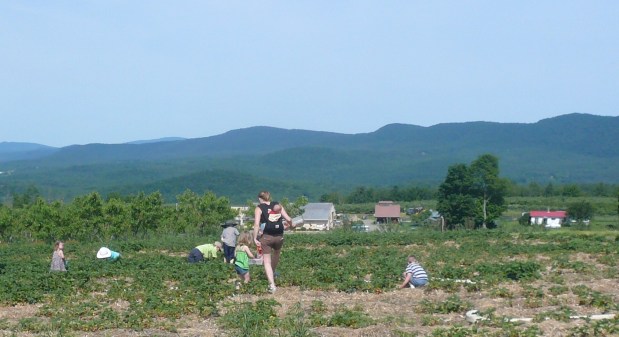
There’s a beautiful pick-your-own strawberry patch in Vermont that I love to visit with my children every summer. It’s been many years and many lovely trips, but there is one moment that will always rise above the rest as the most memorable. I had four little ones; a baby strapped to my back and three others under the age of five. We went early but still the strawberry patch was busy with mostly older ladies and couples who were all serious about getting their berries for the freezer and jam. A few gave the kids quick smiles as we passed and went right back to work. I got down to business as well and started picking as soon as I had everyone settled in spots with plentiful red berries. I kept my children in my peripheral vision and they all seemed content and plopped berries in their little boxes.  It was one of those ‘this is the way life is meant to be’ serene moments. Until, my oldest started yelling…. and I do mean yelling… “MOM!!! He’s peeing on the strawberries!!” I’m sure my head wasn’t the only one that quickly turned and saw my little country-raised three year old peeing across three rows of strawberry plants. The next fifteen minutes are fuzzy. Somehow four kids and a half-filled flat of strawberries made it into the van and part way home without me making eye contact with anyone.  I remember driving along thinking, ‘I can never go back there… ever…”

But, somehow, this week found me picking berries at the same farm, with much older children and a toddler (diaper securely fastened!).  My kids are great, hard workers, and they also love strawberry jam, so they were motivated. We were there at lunch time, and the field was full of children and their mothers. One little boy, uninterested in picking, had wandered off; it looked like he might have found a friend his age and started running around the field. His mother noticed and yelled, “Oliver… Oliver, get back over here!” Her voice was loud enough for everyone in the berry patch to hear and her tone showed her obvious displeasure. With drooping shoulders he slowly made his way back over to her.  She directed him back to picking berries. “See… look at those kids over there.” She pointed to my group of pickers. “Look at how those good little kids are picking berries. Why don’t you start picking like them?”  I cringed. I wanted to go over and grab Oliver’s small hands and say, “Little One, don’t feel bad. On a different day you might have seen these ‘good little kids’ running around like wild things and maybe even peeing on the berries.”

This time, we left with three full flats of strawberries and a few quart baskets held in little hands for the ride home. And, as I drove, my thoughts were still on Oliver and his mother. My thoughts were also on my own children and my own heart when I call them or need to correct them. I prayed for us; I want to laugh and play and rejoice loudly but when I need to speak harder words to do so with quietness and close proximity. When I call my children back from wandering, I want to use the same tone that I would use if it were their birthday and it was time to have cake and ice cream. I delight in my children, even when they are straying, and I want my voice to carry that truth.

As I drove, and pondered the value of quietly correcting my children, I thought of times when my husband has had to speak with one of our boys after church when they were getting a bit too rowdy. I’d see him draw the boy away from the crowd; a father’s hand on his child’s shoulder and his knees bent to look in the boy’s eyes. In that moment, his words aren’t heard by anyone else because they are low and gentle. Instead of seeing the boy’s shoulders droop, I’d see them get taller. I’d see him want to be a man and to do what is right. Most people don’t notice the interaction at all. There isn’t a scene, there aren’t raised voices.  There is no public shame. But the boy is noticed and spoken to and corrected in the quiet presence of his father.

And, I thought, isn’t this just what God does with us?

I spent the summer I turned fourteen with my grandmother. I had a little upstairs room all to myself with a window that looked out over a farm pond, a long field and the sunset. It’s the first time I remember really reading the Bible. I didn’t have commentaries, the internet or even a church family to learn from; just a leather covered New King James version and a lot of time on my hands. Maybe in hindsight it would have been good to start with one of the gospels, like Luke or John, that would have been easier for me to read and gain some context for understanding the rest of the Bible, but I didn’t do that. I just picked it up and decided to read straight through from the beginning.

And, miraculously, that young teen understood and fell in love. It was the start of not just time in a book, but of a relationship with the Author. They were my first moments of being that child with my Heavenly Father pulling me aside and leaning over me; telling me the hardest, sweetest, most beautiful story ever told. Pointing out the ways He’s seen my heart and my actions straying and correcting me with a patient gentleness; assuring me of His love for me now. And, I think most significantly, showing me His attributes and His character and allowing me to know Him. There in that westerly facing room, still a child and alone but for the Spirit of God, I fell in love with the Word of God, both written and manifest in Jesus.

The Word became flesh and made his dwelling among us. We have seen his glory, the glory of the one and only Son, who came from the Father, full of grace and truth. John 1:14

I remember those moments so well that it’s hard to believe so much time has passed since that first summer. The other night my family was all outside playing; I had been tagged and was frozen. I stood admiring my family and the beautiful place we get to live. I looked up at the pointed fir trees, felt the glory of God in nature, and I wondered, ‘what would I believe if I had never read the Bible?’ I tried to separate out everything I had read from what I felt right at that moment. Later I wrote about it in my journal:

What if I didn’t have God’s Word? That is what I wondered as I stood frozen in our game of ‘ball tag’ tonight. I’d know that there is something more powerful than me. I would know that the world was designed and created. I would know there is a battle between life and death. I would feel it even in myself… the struggle to stay on the side of life with goodness and kindness. I would know that there is beauty… and that I can’t quite enter into it… that it is something outside of myself in an almost painful way.  I would know love… the deep love of a mother. I would see the amazing design in each of my children… I would know they came from me and yet I didn’t make them. I think I would know there is God because of prayer… I would want to speak to him and hear him. But I think I would be afraid. I wouldn’t know if God was good or bad or if He loved me. I would be so crushed by His power and the unknown.

And then, while still pondering, I thought of that little children’s hymn, “Jesus loves me this I know, for the Bible tells me so…” Just from studying his creation I would know a lot about God and myself. But I wouldn’t know the gospel… I wouldn’t know that God had entered into His beautiful and yet fallen creation in order to redeem us or of the staggering depth of his love. I might know things about him, but I don’t think I could really know or trust him.

After the game that evening, I sat by our small pond and watched the row boat that had drifted from shore. It was floating aimlessly. I thought of how without the Bible I would have been floating through life on the currents of my feelings. So often, my time in the Word has been that time of being pulled aside and corrected by my Father. The Word exposes my sin; not just the actions but my thoughts and the bent of my heart. I might come to the Word saddened by the evil in the world, or the wrongdoing of others, but when God speaks to me it’s about the tangled knots of sin in my own heart. It’s my own sin that I see crushing Jesus on the cross, and the work Christ did there becomes devastatingly personal in a heartbreakingly beautiful way. “But he was pierced for our transgressions; he was crushed for our iniquities; upon him was the chastisement that brought us peace and with his wounds we are healed.” (Isaiah 53:5) God lifts my eyes to see not just my sin there with Jesus but the death inside of me dying with him. The Word made flesh, dying a fleshly death, so that in me, the Word can bring life.

I return to the Word, and to the cross, over and over and over again. This summer I’ve been reading through the book of Hosea, part of the Old Testament and written hundreds of years before the birth of Jesus. And yet it is all about Jesus. From beginning to end the Bible contains the cross, the ransomed life and the Father calling to his wandering children.

Come, let us return to the Lord;

for he has torn us, that he may heal us;

He has struck us down, and he will bind us up.

After two days he will revive us;

on the third day he will raise us up,

that we may live before him.

Let us know; let us press on to know the Lord;

His going out is sure as the dawn;

He will come to us as the showers,

as the spring rains that water the earth. (Hosea 6:1-3)


It’s raining again this morning as I sit here reading these ancient words. While the rain pours down outside my window, watering my tomatoes and green beans, the words from this long ago prophet are once again watering my soul.  Since I first picked up that Bible as a young teen, there have been a lot of spring rains, many wanderings and many returns. Throughout it all God has remained the same. He has never been the loud and frustrated parent. He has never been embarrassed by my lack of maturity or ashamed of my fumbles. But He has continued with his effectual call, desiring me to return to Him and to His Word. I don’t think it will ever cease to amaze me that it’s not just for our salvation that He calls to us, but it’s for our and His own delight.

The Lord your God is in your midst,

a mighty one who will save;

he will rejoice over you with gladness;

he will quiet you by his love;

he will exult over you with loud singing.

Zephaniah 3:17


Irises… A Poem

IMG_1874

Irises

Purple, smelling like grape juice.
Polly said once, many years ago now,
a neighbor divided the roots,
carried them across a lawn.
“Could you use any irises?
They’re the deep purple ones.
Bloom in June and smell just like grape juice.”
And each spring
they kept dividing,
kept getting carried
to where a neighbor
bent over a garden.
Polly said all the houses on our street
have deep purple irises,
smelling just like grape juice.

Before we left I took my spade,
dug deep into the soil
next to the kitchen door;
the one for neighbors.

Yesterday
a little girl came running
“Mommy, there’s a purple one!”
She always tells me of new flowers.
We’ve had tulips and trillium,
one little lilac and a long path of pink lady slippers.

I smile at her,
here in the woods,
not a neighbor in sight.
“Smell them,” I say.
“They smell just like grape juice.”

Overcoming the Cold

The cold seems to make things quiet.

Outside, the evergreens are weighed down by snow that doesn’t melt; the maples and oaks each stand with arms outstretched and still as if in silent sentry. The only trees left with leaves to chatter when the wind blows are the beeches; they keep gripping them, even all curled and brown. The world is white on top of white with splashes of gray and glimpses of pine green. The chickens stay huddled in the coop and the only tracks we see near the house belong to the dog and the occasional rabbit. Most things are settled down somewhere, quiet.

We’re huddled down, too.  Sometimes we push through and layer and cover and trudge out. But we don’t stay long when it’s below ten degrees and the wind is picking up. The littlest one puts on someone’s boots and a hat on crooked, along with one mitten, and he pats my leg and points to the door. But I scoop him up and try to distract him with a book or a snack or something to make a mess with. The older kids sit near the fire. Two boys sit side by side on the rock hearth. One holds ‘The Return of the King’ and the other holds ‘Prince Caspian’. I think of Tolkien and Lewis an ocean and an epoch away, and something in me is proud of my boys. They are the type that could wear magic rings and do battle or walk through wardrobes and live in castles. We’re huddled together and dreaming bigger.

Something in me is quieter, too. This is what I dreaded in the fall; a cold, snowy winter with cancelled appointments and visits and church. And somehow it’s okay. Maybe because the seed catalogs are appearing in the mailbox every other day. Maybe because I’ve started planning and making sure we have everything we need for making maple syrup. Maybe just because something in me, deep down, has settled like the layers of snow from half a dozen storms.

Yesterday we woke to another foot of snow and an email saying church was cancelled. Before clearing the driveway, my husband helped me bundle little ones and put boots on the right feet. We strapped on snowshoes and loaded up the ice fishing sled with the ones too short to walk in the deep snow. It was bitter. In the woods the cold was biting but when we would come into the open it sliced through the layers with brutality. We made it only as far as the children’s Falkonhurst, a town they’ve created out of sticks and branches and forks in tree trunks. We peeked in each of their ‘cabins’ to see how well they were holding up, and then retreated back to the house to stand by the fire and thaw.

Today, I saw on the news that a woman just a little younger than me was hiking in the mountains not far away yesterday. By 3:30 in the afternoon she was somewhere on the ridgeline and knew she was in trouble. They tried to reach her but with temperatures reaching 30 below last night and unbelievable winds, they couldn’t. It’s one of those news stories that leave you aching.

We are all so much more fragile than we want to believe.

Maybe that’s a strange thing about a cold winter. It shows us things about ourselves. We see how dependent we are on that shrinking firewood pile next to the house. But then, we feel tough as we rush out to grab the next armload. We’re kind of dipping back and forth between feeling like dependents and conquerors.

Sometimes faith feels like that, too.

Another news story made my heart ache today. Twenty one men lined up along a distant shore. In the photographs, you can see the waves rolling in behind them. Twenty one men on their knees, the only words on their lips being, “Help me, Jesus.”

And they were conquerors.

Somewhere inside something has settled in me. It makes me quiet. Prayerful.

This world is cold. There is such a thing as evil and it wants to kill and destroy. It wants to whisper lies. It wants to numb us to what is true and put fear and hate in our bones. It wants to make our temperature the same as that of the world in a winter chill.

But that’s not all there is.

Last night I woke up and heard the wind battering the house. My husband and I were nestled close under the weight of wool blankets. I knew the woodstoves were probably getting low as it had been several hours since they had been loaded and the dampers shut. I thought of my little ones upstairs and downstairs and my husband asleep next to me, all waking up in a few hours. I took the plunge into the cold air and tended the fires.

This winter I’m getting more settled in my need to tend those fires.

“For the one who sows to his own flesh will from the flesh reap corruption, but the one who sows to the Spirit will from the Spirit reap eternal life.  And let us not grow weary of doing good, for in due season we will reap, if we do not give up.” (Galatians 6:8-9)

The cold of this world wants to creep not just through the walls of our house, but wants to creep into my mind and my heart.

The cold wants to numb my affections for Christ; to have me doubt that my faith will be sight someday. The cold wants to chill my marriage with little resentments here and there that go unspoken and unforgiven. It wants to bury my joy as a mother in the mundane tasks that seem more important than snuggling and listening and speaking kindness into little hearts. The cold of this world can make me weary.

But Jesus said, “In this world you will have trouble, but take heart, I have overcome the world.”

The cold doesn’t have to numb and chill and bury and weary. He has overcome the cold.

It’s okay to grow quieter; to be stilled by the cold. But it needs to drive me to tend the fires.

I tend the fires of my faith by drawing near to God; to have a heart that is not quiet toward Him but quiet before Him. It’s opening up the damper when I pray with honesty and rawness. It’s placing seasoned fuel in the fire when I open up the Word and read it until it is saturating my soul more than the drafts that come from circumstance. It’s stirring the coals and blowing fresh oxygen onto the flames when I don’t let snowy roads or a chilled heart keep me from reaching out to loved ones however I’m able. And, as I obey, I can watch the flames leap up and warm my heart so that I don’t give up and so that I can pour the warm harvest of the Holy Spirit into the cold world, starting with those closest to me.

Father,

Thank You for the reality of life beyond this cold world. I know this season of separation is so brief… Only You know when we each will breathe our last breath and what our first moments in the reality of eternity will be. Please let us live our lives close to You so that when that moment comes, it is just a continuation and increase in the intimacy we have grown to experience here. Let us not grow weary in doing good while we have the opportunity. Please let me love my husband and children well while we’re close together in this small house in the middle of winter. And let the love that You grow here, in the quiet and stillness of these woods and of our hearts, overflow into the lives of those we love in other places, and those who we don’t know yet but will love Someday.

Amen

IMG_1498

The Wave Song

She grew up outside of the fog. Where her house sat, there were fields of cows and fields of grasses growing tall for hay. Always surrounding these were hills covered round and green by the tall pines. But on the way to town, before they came to stores and to the only stop light, she would see it; a cloud starting to lift below. The ocean was just ahead; a bay cut deep into the rocky flesh of mid-coast Maine.

In the heat of July and August, sticky sunscreen would be packed beside Italian sandwiches and she could play for the day on the shore. Even before she had words, the waves made poetry deep inside; they lapped against rocks in a steady rhythm that said ‘this is so big and you are so small’. Over and over and over again, the tide coming up unrelenting (stealing shoes if it could) and then releasing its grip on the shore (leaving shell-treasure in recompense).

In school, she sounded out words to tell the story of a sea-witch and wound the tale around with waves and weeds and dashed wickedness. When she turned in her paper, she watched from her desk as her teacher read it, saw her smile and leave the room with the story still in her hands. And the girl wondered and didn’t know.

Little Lara at the Beach

Later, she didn’t have to sound out her words anymore; they were emotions decoded and thoughts sorted and composition books were stacked under her bed. In her first creative writing class, teenagers sat in a circle and she read her poem aloud. When she looked up, her teacher had tears streaming down her face and left the circle for tissues. And the girl wondered and realized that words aren’t just for her to sort but that they connect and stretch across space and bring people close.

In college, the girl would drive her car to the ocean. She sat overlooking the bay and wrote poems about sailboats and the wind and being on the shore. One night she stayed with a friend in a little house where she could hear waves and smell salt. In the morning she woke to the thudding sound of lobster boats. As she scrounged for breakfast, she watched the pretty sea gulls circling over the boats and scavenging as well. She scribbled out a lobsterman poem and, even though a Mainer all her life, as she thought of them pulling traps out in the chilly morning, she realized she was just a tourist at the sea side.

That fall she met a boy with hair bleached blonde from working all summer on the ocean. He called sea gulls rats and didn’t think they were pretty at all. He teased her about her little bay with the gentle waves and showed her the ocean where the waves were wild and crashed and where when you look out into the ocean it was like looking up at the stars in the sky, seeming to stretch on and on for infinity.

Soon, she started writing poems with a ring on her hand and delicately put the word ‘fiance’ in her prose whenever she could make it fit. There was marriage and moving far from the ocean and a baby was born. She held the new little one in her arms and again, felt the wave song swelling up inside, “this is so big and you are so small.”

The boy knew his wife missed the cow fields and hay fields and before long they had a farm and a farmer’s family; half a dozen babies trying to help pull weeds and mend fences. She was so happy she forgot all about the ocean and the stories. Her hands were too busy for pen and paper. The ocean was only thought of on those hot summer days when they stacked hay bales and longed for a cool sea breeze to dry their sweat. Sometimes, when the hay field was past due for mowing, a light summer wind would send rippling waves through the grass. She’d catch her breath and for a moment, as she watched the timothy bend and bow and lift again, she was beside the sea again. A poem would start to swell like a wave but then there was lunch to make and a baby to put down for her nap and the sheep had broken the temporary fence and were in with the cows. Her thoughts didn’t need to be sorted as much as the laundry waiting in piled baskets.

But then, came a summer of breaking on the farm. The boy and girl sold their animals and old farmhouse and their farm kids became kids with tree forts and hatchets. Their new house sat on a pine covered hill with big windows looking west. So, she would gaze over the rolling hills below and into the big sky above with her back turned to the ocean. She didn’t think about waves or salty air, but she thought about miles and dirt roads and stars in the sky. The miles and the dirt road would sometimes taunt her with their song, ‘you are so alone, so far away’. But every now and then, the stars would whisper to her the wave song, ‘this is so big and you are so small’. Slowly, a swell of stories started to rise inside her heart. Sometimes she walked with her children in the woods and told them stories; a fairy named Perchance had been blown away from fairy land during a storm (when she didn’t listen to her mommy and come inside) and was now wandering about the woods. She was shy but lonely so she loved to follow children and would sometimes leave little gifts in the trail for them. And the farm kids turned woods kids would walk with quiet feet and try to catch a glimpse. They would look in stumps and under leaves and they would find Perchance’s gifts of acorns and shiny rocks and funny shaped sticks.

And the girl-now-mother-in-the-woods started filling her journals again. She even wrote a poem or two. But she was still looking west out her windows and the dirt roads still taunted her with loneliness. She remembered how her teacher had cried and how her words had gone out of her heart into someone else’s and connected them with strings of understanding. She decided to share her ‘walk in the woods’ and would sometimes find a story pressing in and out. So, she would take her heart and put it into words on a computer screen and when she pressed ‘share’ somehow her words bypassed the long dirt road on their way to other screens and into other hearts. And sometimes, words would come back to her. Sometimes other hearts would be put into words and a wave of connection and love would swell.

Sometimes the girl even started to feel wise. When she wrote she would pray and have the Words of the Master of all Words by her side. His Word came in like a tide at the ocean; where there was once a tangle of weeds and rubbish the deep waters would come and rest. And then, as the tide receded she found it had taken much of the debris and left behind treasures of truth glimmering for her to pick up and make her own. She started longing to share these treasures gleaned from the deep tides rolling over her soul. This longing could possess her; she craved the tides and the washing and the sharing and the hearts being strung together with strings of wisdom. She started wanting to spend her day stringing together words and checking and rechecking them.

But she was still a mother and a wife and a housecleaner and a schoolteacher and… on and on it could go. One night, she and the boy sat face to face with their New Years’ sparkling cider in their hands. And, they talked about the year ahead and she knew there was more to do than she could ever, ever do. She looked at this boy whose hair was brown now and who worked so hard and she wanted to do whatever she could to make their life happy in the woods. So, she decided to cut out the words and the stories and the sharing. She would make her hands busy with dishes and laundry and school books and diapers and do it without the distraction of the stories pushing up and in and out.

And she tried. She put schedules in place and made her hands as busy as they could be. And her house was a bit cleaner and she thought, ‘Yes… this is right. This is what I needed to do.’

But at night, she started dreaming of the ocean. The waves woke her from her sleep and she was thirsty with desire to be standing on rocks with salt air blowing her hair and wild waves crashing below.

And, neither the girl nor the boy was happier in their tidier house in the woods. After a while, her heart sank with this knowledge. She could do and do and do and do and do and all the while there was more. One day, she took an old board and painted the words, “Our home, a place to BE” and hung it on the wall. And, throughout the day, she would look at the crooked letters and wonder how to ‘be’ and how to let others ‘be’.

IMG_1325

And all the while, she prayed that the Master of all Words wouldn’t wash over her with His tide. She couldn’t bear to see the treasures shining and know she had given up stories. They were the only thing she could think of to let go because dinner needed to be made and children needed to be snuggled and socks needed matching. But she didn’t need to write.

Though at night, she kept dreaming of waves and sometimes they were gentle and sometimes they came crashing down and made her afraid.

Just before she sank down under the weight of the doing and the crashing waves, the Master of All Words gave her counselors kinder than those of Job. One was on her way to the ocean, and gave her the gift of listening and belief and confidence in her stories. Another wrote from the desert, and sang songs over her like the tide washing up and over and around, strengthening and stilling.

And the girl knew. She needed to write. She needed to weave stories while walking with her children and write love letters to her husband and to let the Word wash her and speak it back in ways that connect her to people beyond her long dirt road. She needed to let go of ‘doing’ her writing with its checking and rechecking and trying to be wise and to just ‘be’ and write like she inhales and exhales. She wouldn’t write to teach but she would write for healing and to love. She wouldn’t worry about her grammar or style or being pretty for other people… she doesn’t have time for all of that. But she would write like she was standing by the shore and listening to the waves crash.

And, while her windows still face west, she’s holding tight to something better than the ocean welling up inside. She has the One who thought of the seas and spoke them into being with His Word. She has the One who looked at the crashing waves and told them to ‘Be Still’ and they quieted. So, she can listen to His song in her heart, and write to and through and for the One who calls out, over and over and over again, ‘this is so big and you are so small.’