Home At Last

Home At Last

“I could not look upon the peaks of Ascutney, Killington, Mansfield, and Equinox, without being moved in a way that no other scene could move me. It was here that I first saw the light of day; here I received my bride, here my dead lie pillowed on the loving breast of our eternal hills.”

-Calvin Coolidge, (on visiting his home state of Vermont)

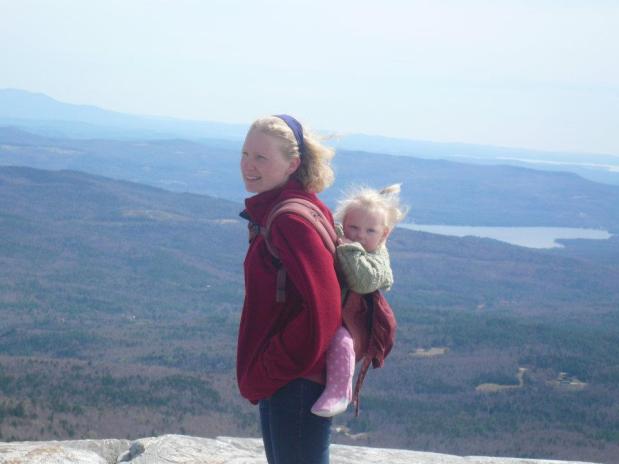
In Maine, just as the blueberries were nearing their peak, I stood with my family on top of Haystack Mountain. I’ve always had trouble when people ask me where I’m from in Maine, in narrowing it down to a town. What I’d like to say is that I’m from the view off of Haystack.

That July night, after dinner but before dusk, I stood with my mother and we pointed out the places. Off to the east, in Searsmont, it was easy to pick out the patch of earth that was my father’s land. Forty six acres in the back section had burned in a forest fire this spring; you could see a gray rectangle of trees that had been charred and blackened and wouldn’t be bearing green leaves again. Closer to us would be the vegetable gardens, with cucumbers, beans and maybe my father bent over some weeds.

I moved my gaze slightly northward and could see the gap in the trees where the road stretches away to Belfast on the coast. Somewhere there, out of site, rests Islesboro in deep salt water and in the far distance, its steady gaze over both the ocean and the inlands, stood Blue Hill looking back at us.

Bringing my eyes closer again, I could see the Kingdom, where Cram Pond stands quiet and still but remembers when the mills and houses and school stood along the river and filled its shores with people. Stories still echo over the water like the eeriness of loon calls. It’s where my grandmother was born, one of seven children, and where my great-grandmother ran and wept by the waterfalls when she lost her husband. The powerful rush of water still tumbles down, all these years after her tears joined them in their course.

Past the Kingdom runs the road to Morrill. I could see it tucked into the hills in the north, hiding my sister’s houses, my grandfather’s and the church where my husband and I were married. It’s there that my sisters and I used to ride our horses across the side of Frye Mountain, passing one grandmother’s house on Rowe Hill and coming out hours later just below the other’s on Morey Hill. Frye Mountain, like Cram Pond, is a place where stories lie thick. Thirty-seven cellar holes are left up there, with apple trees growing beside in a wilderness. There used to be beautiful old farmhouses, with water running from springs in the side of the mountain into kitchens, and with big barns housing horses, cows and sheep. Once I stood with my grandfather as we looked from his house to Frye Mountain; he told me that he could still remember when there was barely a tree over there on the side of that hill. Looking at the trees covering it completely like a thick, tucked-in blanket, I almost didn’t believe him, though the miles of stone walls where pastures once were tell the same story.

Past Frye Mountain to the northwest is Hogback Mountain. They say that many years ago, two of my great great grandfathers were friends and could bellow back and forth from where they each lived on the side of the hills, having conversations across the miles. There are still stories echoing. They echoed all over, from every direction, as I stood and looked out at the view from Haystack Mountain.

Following Hogback, and coming closer West again, my mother pointed out the place where her own house sits in Montville. We moved there when I turned ten. That same year one sister went off to college, one sister left to get married, and my mother got remarried herself.  She and my stepfather bought the Montville house together, and moved my little sister and me to a new town with a new school district. It seemed at the time like I had been torn from my roots; all that was familiar and loved had been left behind. Now, it blends easily into the landscape of home as seen from Haystack Mountain. Even the house itself sits in a place that echoes family history. When my grandmother was a girl, her mother a widow, they left the Kingdom and moved right to the spot where my mother and stepfather dragged me so unwillingly. When my grandmother came to visit us that first year, she told stories of when she lived just down the hill and used to walk to attend school in what is now the house across the street from my mother’s.  She said something like, “I’ve been right here in this room before. The lady who used to live here was a seamstress and she was doing some sewing for a little girl. She saw me going to school and thought I was about the same size as that little girl. She asked me to come in so she could size a dress.” And in that spot where I felt so far from home, my grandmother said, “I’ve been right here before.”

Leaving Maine, and the view from Haystack, was difficult this time. Sort of like when I was ten, and didn’t want to leave Morrill, my heart kept crying out, ‘but that is home’.  And I shed some tears, and I had some attitude about living away, and I finally decided that I didn’t have to be on top of Haystack to look back toward home. I started looking for the stories. I decided to research and write about those places, and was drawn especially to the forgotten and echoey places like Frye Mountain and the Kingdom that are so rich with history.

And, I’m finding the stories. I’m finding that so many people have been right here before.

There are old family papers my grandfather collected in two briefcases with finicky latches, photos and newspaper clippings, letters and genealogies spreading over pages like branches or roots. A library archive of interviews about Frye Mountain were waiting like treasures in a mine; I’ve been pouring over transcripts that hold voices of a generation that is fast disappearing, telling stories of generations that they are the only ones who remember. There are maps marked with family names and old names on roads and corners and gravesites. Names copied from family Bibles, names from lists of men going off to war, names with just dates of birth and marriage and death. Names that are all we have left of each life full of stories. Names that tell us that so many people have been right here before.

Spending time with these names, and the stories that I have in pieces from times past, is helping me with my homesickness; maybe even by taking it to a deeper level that is truer. It’s reminding me that, despite how firm a stake in life we feel like we have as we work and entertain ourselves, we will only hold our place here for so long; day passes day and it wasn’t so long ago that others stood on these hills surveying the landscape. It isn’t so long before our turn will be past and others will take our place. And perhaps in a surpassing way, when we reach heights where we can see beauty and expanse, our hearts are moved by longing. There’s an echo in the air of a deeper, greater story. In a way, no matter where on earth we tread, as we strain our ears for the rest of the story, there’s a pang of homesickness in our souls. It’s okay to not be totally satisfied. There’s appropriateness in not feeling a sense of complete belonging. There’s a call in the air but it hasn’t been answered. It isn’t the time yet that we can finally say, with those who have gone on ahead of us, that we are truly ‘home at last!’

“I have come home at last! This is my real country! I belong here. This is the land I have been looking for all my life, though I never knew it till now…”

CS Lewis, from ‘The Last Battle’
God’s Gentle Parenting (Or Why I Love the Bible)

God’s Gentle Parenting (Or Why I Love the Bible)

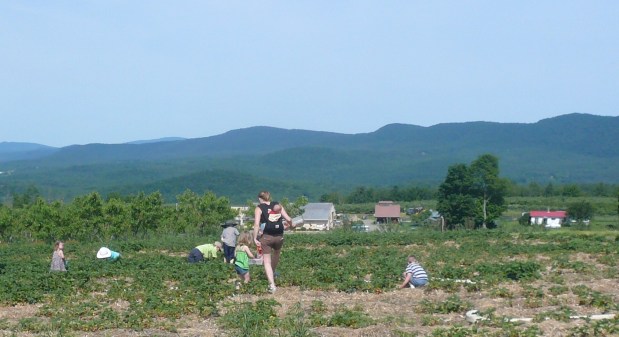
There’s a beautiful pick-your-own strawberry patch in Vermont that I love to visit with my children every summer. It’s been many years and many lovely trips, but there is one moment that will always rise above the rest as the most memorable. I had four little ones; a baby strapped to my back and three others under the age of five. We went early but still the strawberry patch was busy with mostly older ladies and couples who were all serious about getting their berries for the freezer and jam. A few gave the kids quick smiles as we passed and went right back to work. I got down to business as well and started picking as soon as I had everyone settled in spots with plentiful red berries. I kept my children in my peripheral vision and they all seemed content and plopped berries in their little boxes.  It was one of those ‘this is the way life is meant to be’ serene moments. Until, my oldest started yelling…. and I do mean yelling… “MOM!!! He’s peeing on the strawberries!!” I’m sure my head wasn’t the only one that quickly turned and saw my little country-raised three year old peeing across three rows of strawberry plants. The next fifteen minutes are fuzzy. Somehow four kids and a half-filled flat of strawberries made it into the van and part way home without me making eye contact with anyone.  I remember driving along thinking, ‘I can never go back there… ever…”

But, somehow, this week found me picking berries at the same farm, with much older children and a toddler (diaper securely fastened!).  My kids are great, hard workers, and they also love strawberry jam, so they were motivated. We were there at lunch time, and the field was full of children and their mothers. One little boy, uninterested in picking, had wandered off; it looked like he might have found a friend his age and started running around the field. His mother noticed and yelled, “Oliver… Oliver, get back over here!” Her voice was loud enough for everyone in the berry patch to hear and her tone showed her obvious displeasure. With drooping shoulders he slowly made his way back over to her.  She directed him back to picking berries. “See… look at those kids over there.” She pointed to my group of pickers. “Look at how those good little kids are picking berries. Why don’t you start picking like them?”  I cringed. I wanted to go over and grab Oliver’s small hands and say, “Little One, don’t feel bad. On a different day you might have seen these ‘good little kids’ running around like wild things and maybe even peeing on the berries.”

This time, we left with three full flats of strawberries and a few quart baskets held in little hands for the ride home. And, as I drove, my thoughts were still on Oliver and his mother. My thoughts were also on my own children and my own heart when I call them or need to correct them. I prayed for us; I want to laugh and play and rejoice loudly but when I need to speak harder words to do so with quietness and close proximity. When I call my children back from wandering, I want to use the same tone that I would use if it were their birthday and it was time to have cake and ice cream. I delight in my children, even when they are straying, and I want my voice to carry that truth.

As I drove, and pondered the value of quietly correcting my children, I thought of times when my husband has had to speak with one of our boys after church when they were getting a bit too rowdy. I’d see him draw the boy away from the crowd; a father’s hand on his child’s shoulder and his knees bent to look in the boy’s eyes. In that moment, his words aren’t heard by anyone else because they are low and gentle. Instead of seeing the boy’s shoulders droop, I’d see them get taller. I’d see him want to be a man and to do what is right. Most people don’t notice the interaction at all. There isn’t a scene, there aren’t raised voices.  There is no public shame. But the boy is noticed and spoken to and corrected in the quiet presence of his father.

And, I thought, isn’t this just what God does with us?

I spent the summer I turned fourteen with my grandmother. I had a little upstairs room all to myself with a window that looked out over a farm pond, a long field and the sunset. It’s the first time I remember really reading the Bible. I didn’t have commentaries, the internet or even a church family to learn from; just a leather covered New King James version and a lot of time on my hands. Maybe in hindsight it would have been good to start with one of the gospels, like Luke or John, that would have been easier for me to read and gain some context for understanding the rest of the Bible, but I didn’t do that. I just picked it up and decided to read straight through from the beginning.

And, miraculously, that young teen understood and fell in love. It was the start of not just time in a book, but of a relationship with the Author. They were my first moments of being that child with my Heavenly Father pulling me aside and leaning over me; telling me the hardest, sweetest, most beautiful story ever told. Pointing out the ways He’s seen my heart and my actions straying and correcting me with a patient gentleness; assuring me of His love for me now. And, I think most significantly, showing me His attributes and His character and allowing me to know Him. There in that westerly facing room, still a child and alone but for the Spirit of God, I fell in love with the Word of God, both written and manifest in Jesus.

The Word became flesh and made his dwelling among us. We have seen his glory, the glory of the one and only Son, who came from the Father, full of grace and truth. John 1:14

I remember those moments so well that it’s hard to believe so much time has passed since that first summer. The other night my family was all outside playing; I had been tagged and was frozen. I stood admiring my family and the beautiful place we get to live. I looked up at the pointed fir trees, felt the glory of God in nature, and I wondered, ‘what would I believe if I had never read the Bible?’ I tried to separate out everything I had read from what I felt right at that moment. Later I wrote about it in my journal:

What if I didn’t have God’s Word? That is what I wondered as I stood frozen in our game of ‘ball tag’ tonight. I’d know that there is something more powerful than me. I would know that the world was designed and created. I would know there is a battle between life and death. I would feel it even in myself… the struggle to stay on the side of life with goodness and kindness. I would know that there is beauty… and that I can’t quite enter into it… that it is something outside of myself in an almost painful way.  I would know love… the deep love of a mother. I would see the amazing design in each of my children… I would know they came from me and yet I didn’t make them. I think I would know there is God because of prayer… I would want to speak to him and hear him. But I think I would be afraid. I wouldn’t know if God was good or bad or if He loved me. I would be so crushed by His power and the unknown.

And then, while still pondering, I thought of that little children’s hymn, “Jesus loves me this I know, for the Bible tells me so…” Just from studying his creation I would know a lot about God and myself. But I wouldn’t know the gospel… I wouldn’t know that God had entered into His beautiful and yet fallen creation in order to redeem us or of the staggering depth of his love. I might know things about him, but I don’t think I could really know or trust him.

After the game that evening, I sat by our small pond and watched the row boat that had drifted from shore. It was floating aimlessly. I thought of how without the Bible I would have been floating through life on the currents of my feelings. So often, my time in the Word has been that time of being pulled aside and corrected by my Father. The Word exposes my sin; not just the actions but my thoughts and the bent of my heart. I might come to the Word saddened by the evil in the world, or the wrongdoing of others, but when God speaks to me it’s about the tangled knots of sin in my own heart. It’s my own sin that I see crushing Jesus on the cross, and the work Christ did there becomes devastatingly personal in a heartbreakingly beautiful way. “But he was pierced for our transgressions; he was crushed for our iniquities; upon him was the chastisement that brought us peace and with his wounds we are healed.” (Isaiah 53:5) God lifts my eyes to see not just my sin there with Jesus but the death inside of me dying with him. The Word made flesh, dying a fleshly death, so that in me, the Word can bring life.

I return to the Word, and to the cross, over and over and over again. This summer I’ve been reading through the book of Hosea, part of the Old Testament and written hundreds of years before the birth of Jesus. And yet it is all about Jesus. From beginning to end the Bible contains the cross, the ransomed life and the Father calling to his wandering children.

Come, let us return to the Lord;

for he has torn us, that he may heal us;

He has struck us down, and he will bind us up.

After two days he will revive us;

on the third day he will raise us up,

that we may live before him.

Let us know; let us press on to know the Lord;

His going out is sure as the dawn;

He will come to us as the showers,

as the spring rains that water the earth. (Hosea 6:1-3)


It’s raining again this morning as I sit here reading these ancient words. While the rain pours down outside my window, watering my tomatoes and green beans, the words from this long ago prophet are once again watering my soul.  Since I first picked up that Bible as a young teen, there have been a lot of spring rains, many wanderings and many returns. Throughout it all God has remained the same. He has never been the loud and frustrated parent. He has never been embarrassed by my lack of maturity or ashamed of my fumbles. But He has continued with his effectual call, desiring me to return to Him and to His Word. I don’t think it will ever cease to amaze me that it’s not just for our salvation that He calls to us, but it’s for our and His own delight.

The Lord your God is in your midst,

a mighty one who will save;

he will rejoice over you with gladness;

he will quiet you by his love;

he will exult over you with loud singing.

Zephaniah 3:17